FTL vs LTL shipping in Europe: how to choose the right freight mode
FTL vs LTL shipping in Europe explained: compare full truckload and groupage on cost, transit, LDM thresholds and EU driver shortage impact.

Logifie Team
Logistics Technology Experts
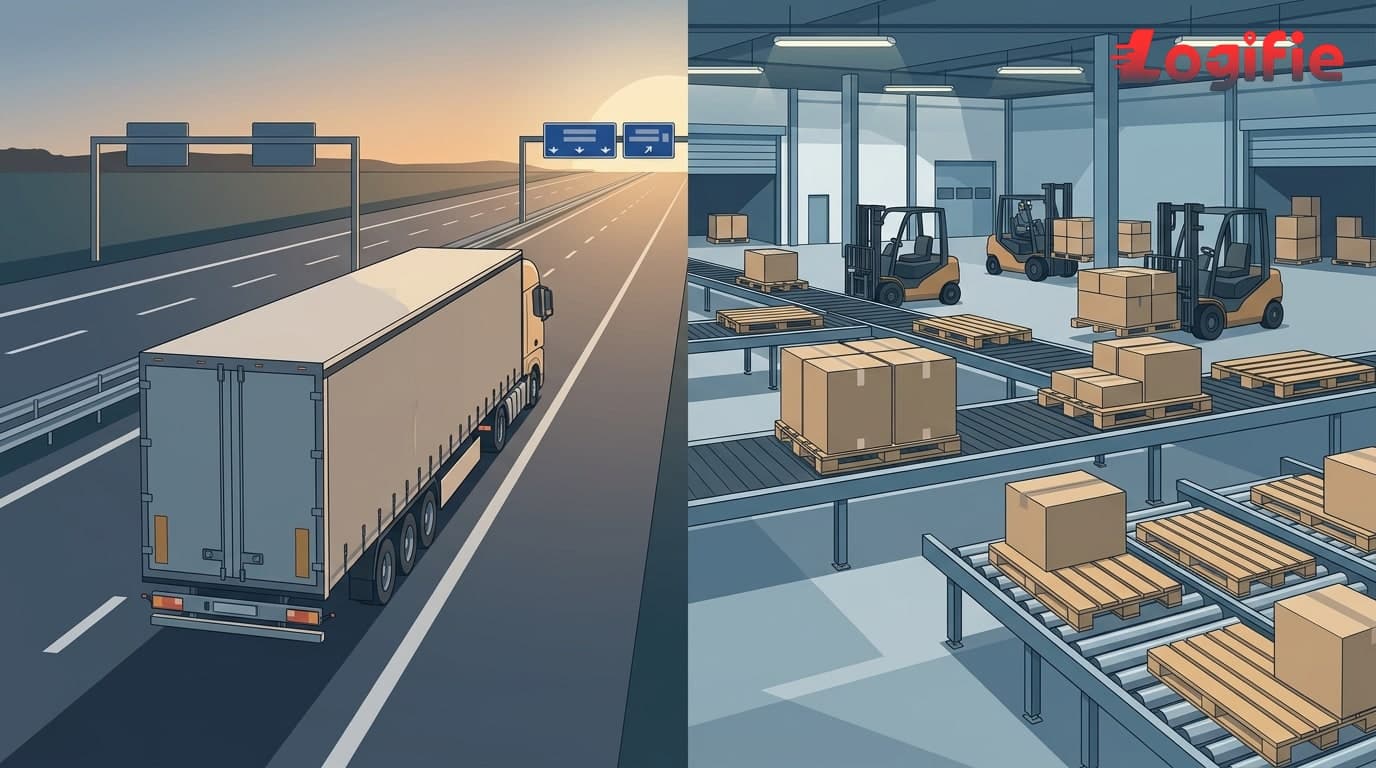
FTL (full truckload) means you book an entire trailer for one shipment that travels directly from origin to destination, while LTL (less than truckload), known in most of Europe as groupage, means your goods share a trailer with consignments from other shippers and pass through one or more sorting hubs on the way. The choice matters more than ever in 2026: the IRU recorded 426,000 unfilled HGV driver positions across Europe in 2024 , up from 233,000 the year before, and EU diesel has hovered around EUR 1.90 to 2.10 per litre this year, so paying for empty trailer space is an expensive mistake. This guide explains both modes in European terms, compares them side by side, and gives you a plain checklist for deciding which one fits a given load.
426,000
Unfilled HGV driver positions recorded by the IRU across Europe in 2024, up from 233,000 the previous year — the shortage that makes paying for empty trailer space especially costly.
EUR 1.90–2.10/L
Average diesel pump price across EU member states in 2026, with taxes making up close to half. Every kilometre of empty trailer space burns this fuel.
Road carries the overwhelming majority of Europe's overland freight. Eurostat data published in 2026 shows road freight reached 25.7 percent of all EU freight tonne-kilometres in 2024 , and once maritime traffic is set aside, road accounts for roughly three-quarters of inland freight movement. That dominance is exactly why getting the FTL-versus-LTL decision right has a direct line to your transport budget.
What is FTL (full truckload) shipping?
FTL is the booking of a complete vehicle for a single shipment. The trailer is dedicated to your goods, so it loads at your site, drives directly to the delivery point, and is not consolidated with anyone else's freight along the way. In European road freight, the reference vehicle is the 13.6-metre curtainsider trailer, which takes 33 euro pallets on the floor (34 in a double-deck configuration) and carries a payload in the region of 24 tonnes.
Because the truck moves point to point with no intermediate handling, FTL offers the fastest transit and the lowest damage risk of the two modes. You pay for the whole vehicle whether or not it is physically full, which is why FTL becomes economical only once a load is large enough to justify exclusive use. When you need to know exactly who is putting that vehicle on the road, it helps to understand who arranges FTL and LTL moves before you commit to a contract.
What is LTL shipping, and how does it relate to European groupage?
LTL is the shipping of consignments too small to fill a trailer on their own. The carrier consolidates several shippers' goods into one vehicle, so each customer pays only for the space their freight occupies. In Europe the everyday term for this is groupage — the grouping together of multiple part-loads — and the two words are used almost interchangeably across the continent.
The trade-off is handling. LTL freight is collected, brought to a sorting depot, cross-docked onto line-haul vehicles, and often broken down again at a regional hub before final delivery, so it passes through more touchpoints than a full load. That extra handling is why packaging and pallet quality matter so much for groupage, and why end-to-end visibility is valuable. If your consignment moves through several depots, the ability to track multi-stop groupage shipments end to end turns an opaque network into something you can actually plan around.
FTL vs LTL: what are the key differences at a glance?
The table below sets out the core trade-offs in European units. Use it as a quick reference, then read the decision section for the thresholds.
| Factor | FTL (full truckload) | LTL / groupage (less than truckload) |
|---|---|---|
| Typical load size | 10+ loading metres (LDM), roughly 22 to 33 pallets, up to about 24 tonnes | 1 to 6 LDM, roughly 1 to 10 pallets, part of a shared trailer |
| Cost structure | Flat price for the whole vehicle, regardless of fill | Priced by space used (LDM or pallet) plus weight; you pay only for your share |
| Transit time | Fastest; direct origin to destination, no hub stops | Slower; routed through one or more sorting depots |
| Handling and damage risk | Lowest; goods loaded once and not touched again until delivery | Higher; multiple cross-dock and reload touchpoints |
| Flexibility | Best for predictable, schedulable point-to-point volume | Best for frequent small shipments and flexible delivery windows |
| Best for | Large, dense, time-critical or fragile loads filling most of a trailer | Small to medium consignments where cost per unit shipped matters most |
US freight class does NOT apply in Europe. The NMFTA freight-class system governs American LTL pricing but is not used anywhere in Europe. European groupage is priced on loading metres (LDM), pallet count and weight — not on a commodity class number. When comparing European quotes, you are comparing LDM and pallets, not freight classes or linear feet.
When should you choose FTL over LTL?
Choose FTL when your load is large enough to occupy most of a trailer, when transit speed is critical, or when the goods are fragile or high-value enough that extra handling is a real risk. As a European rule of thumb, once a shipment passes roughly 10 to 13 loading metres — the point where it approaches a full 13.6-metre trailer — a full load is usually both faster and cheaper per unit than groupage, because you are no longer subsidising the handling overhead of a shared network.
FTL also wins on predictability. A direct vehicle has fewer points of failure than a consolidated one, so for production-line deliveries or anything on a tight appointment window, the dedicated trailer earns its premium. Shippers running regular full loads should find carrier capacity for full and partial loads well ahead of peak periods, because the driver shortage tightens availability fastest for the predictable, schedulable lanes that FTL depends on.
When is LTL or groupage the better choice?
Choose LTL or groupage when your consignment is too small to justify a whole trailer and you would otherwise be paying for empty space. For loads in the 1-to-6 LDM band, roughly one to ten pallets, groupage almost always gives a lower total cost because you split the vehicle and its fuel bill with other shippers. With diesel near EUR 1.90 to 2.10 per litre across the EU in 2026 and taxes making up close to half of that pump price, the saving from not moving a half-empty truck is substantial.
Groupage also suits businesses that ship little and often. If you dispatch a few pallets several times a week to scattered destinations, a network of consolidation hubs reaches more places, more frequently, than you could ever justify with dedicated vehicles. The cost is time and handling, so it is the right call when delivery windows are flexible and the goods are well palletised.
What about part-load options between FTL and LTL?
Between the two extremes sits the part-load, sometimes abbreviated PTL. A part-load is bigger than typical groupage but does not fill a trailer — think roughly 6 to 10 loading metres. Here the carrier combines two or three substantial consignments rather than dozens of small ones, so there is less handling than full groupage but more flexibility than a dedicated truck. Many European loads fall into this middle band, and it is often the cheapest option for a 10-to-20-pallet shipment that is awkward for both pure LTL and pure FTL.
The practical difficulty is that the part-load sweet spot shifts with lane, season and capacity. This is where software earns its place: rather than guessing, you can automate FTL vs LTL decisions with a TMS that compares full-load, part-load and groupage rates for the same consignment and flags the cheapest viable mode. When you have settled on the right mode, you can request a quote for a full-load or part-load shipment and lock in capacity.
How do FTL and LTL costs compare in Europe?
FTL is priced as a single rate for the vehicle, so the cost per pallet falls as you fill the trailer and rises sharply if you ship it half empty. LTL is priced on the space your freight occupies, measured in loading metres or pallet slots and adjusted for weight, so a light, bulky load can cost as much as a dense, heavy one of the same footprint. The crossover point is the practical question, and it moves with the market. European road freight rates have been volatile through 2024 and 2025; market intelligence such as the Upply European road freight rate index tracks these swings and shows how the FTL-versus-groupage balance shifts quarter to quarter.
Driver and fuel costs sit underneath both modes. The same driver shortage the IRU is tracking pushes up the cost of the dedicated vehicle that FTL requires, while fuel feeds into every kilometre regardless of mode. Cabotage and posting rules under the EU Mobility Package, set out in EU Regulation 2020/1055 , also shape what carriers can charge on cross-border lanes, which is why the cheapest mode on a domestic lane is not always cheapest internationally.
Frequently asked questions
What does FTL mean in shipping?
FTL stands for full truckload. It means you book an entire trailer for a single shipment that travels directly from collection to delivery without being consolidated with other shippers' goods. You pay one rate for the whole vehicle, so FTL is most economical once your load fills most of a standard 13.6-metre trailer.
What is the difference between LTL and groupage?
There is no practical difference. LTL (less than truckload) is the international term, and groupage is the word used across most of Europe for the same thing: consolidating several shippers' part-loads into one trailer so each pays only for the space used. European carriers price both on loading metres and pallets rather than the US freight-class system.
How many pallets is FTL versus LTL in Europe?
As a rule of thumb, 1 to 10 pallets (about 1 to 6 loading metres) is groupage or LTL, 10 to 22 pallets is a part-load, and a shipment approaching 22 to 33 pallets, or roughly 10 loading metres and above, is usually best as a full truckload. A standard 13.6-metre trailer holds 33 euro pallets on the floor.
Is FTL or LTL cheaper?
It depends on load size. For small consignments, LTL is far cheaper because you share the vehicle and fuel costs with other shippers rather than paying for empty space. Once a load fills most of a trailer, FTL becomes cheaper per pallet and is also faster, because there is no hub handling. The crossover sits around 10 to 13 loading metres.
Which is faster, FTL or LTL?
FTL is faster. A full truckload moves directly from origin to destination with no intermediate stops, while LTL and groupage are routed through one or more sorting depots where freight is cross-docked and reloaded. If transit time is critical, FTL is the safer choice even when the trailer is not completely full.
Does US freight class apply to LTL in Europe?
No. The NMFTA freight-class system governs LTL pricing in the United States but is not used in Europe. European groupage is priced on loading metres, pallet count and weight. When you compare European quotes you are comparing LDM and pallets, not a commodity class number or linear feet.
Whether you are moving a single pallet or a full 13.6-metre trailer, the right mode depends on size, speed and handling tolerance rather than habit. When you are ready to put a load on the road, request a quote for a full-load or part-load shipment and let the numbers, not guesswork, decide.

